Showing posts with label Personality Types. Show all posts

Sunday, March 15, 2026

What Really Makes Me Who I Am


Other Articles About "Human Personality"    See Other Book Summaries on "Goal Setting"
Download Book    Download Chapter    <<< Previously    Next >>>

Taken from the 4th chapter of the book: Goals by Brian Tracy

“One universe made up of all that is: and one God in it all, and one principle of being, and one law, the reason shared by all thinking creatures, and one truth.”

What really makes me the person I am? Is it my habits, my tone of voice, my choices, my successes, my failures, the way I treat people, or the things I believe about myself when no one else is watching? I have come to believe that personality is not something superficial. It is not just charm, confidence, talent, style, or social ease. My personality is built from the inside out.

At the center of who I am are my values. Everything else grows from there.

If I do not know my values, I may still move through life, make decisions, chase goals, and react to people and events. But I do so in a fog. I become inconsistent. I say one thing, feel another, and do something else. I may even appear successful while feeling strangely disconnected from myself. The more clearly I know what matters most to me, the more coherent my life becomes. My personality stops feeling random and starts feeling rooted.

Values: The Center of My Inner Life

I think of my personality as a set of rings radiating outward. At the center are my values. They are the deepest standards by which I judge what is good, meaningful, right, worthwhile, and worthy of commitment. They shape what I admire, what I reject, what I endure, and what I pursue.

If I value honesty, then dishonesty unsettles me even when it benefits me. If I value kindness, then cruelty feels wrong even when it is socially rewarded. If I value dignity, then I cannot comfortably live by humiliation, manipulation, or self-betrayal. My values define the moral climate of my inner world.

That is why personality, to me, is not just outward behavior. It is the structure beneath behavior.

Beliefs: The Story My Values Create

My values do not stay hidden at the center. They shape my beliefs. What I value becomes what I believe about myself, other people, and life itself.

If I value compassion, I am more likely to believe people deserve patience. If I value growth, I am more likely to believe change is possible. If I value resentment, fear, or superiority, then those values also become beliefs: that people are threats, that the world is harsh, that I must dominate before I am dominated.

This is why values matter so much. They become the lens through which I interpret reality.

My beliefs are not floating ideas detached from my character. They are often the natural extension of what I honor deep inside. If I believe I am capable of decency, effort, courage, and renewal, that belief usually rests on values I have either consciously chosen or unconsciously absorbed.

Expectations: The Future I Quietly Prepare For

From beliefs come expectations. What I believe starts teaching me what to expect.

If I believe I am fundamentally powerless, I begin to expect disappointment. If I believe life is only struggle, I expect betrayal, loss, and frustration. If I believe that effort matters, that goodness is possible, and that meaning can be made, I begin to expect something different. I become more open, more resilient, more future-oriented.

My expectations affect the emotional atmosphere in which I live. They shape whether I approach life with dread or readiness, suspicion or openness, bitterness or hope.

And this matters because I often behave in anticipation of what I expect. If I expect rejection, I may withdraw before anyone rejects me. If I expect growth, I may keep working through difficulty. The future I expect begins influencing the person I become in the present.

Attitude: My Inner Weather on Display

My attitude is not an isolated trait. It is an outward expression of what is already happening inside me. It reflects my values, my beliefs, and my expectations.

That is why attitude is rarely just about being cheerful or gloomy. It is deeper than mood. It is the way I stand before life. It is the tone I bring into work, relationships, setbacks, and possibility. My attitude reveals whether I secretly trust life, whether I respect myself, whether I think effort matters, whether I think people are worth meeting with generosity.

When I look at attitude this way, it stops being cosmetic. It becomes diagnostic. It tells me something about what I truly believe.

Actions: Where My Personality Becomes Visible

At the outermost ring are my actions. This is where the invisible becomes visible.

I can claim almost anything about myself, but my actions eventually tell the truth. Under comfort, I may be able to perform a certain identity. Under pressure, my real priorities emerge. What I do repeatedly, especially when it is inconvenient, reveals what I value most.

That is why one of the hardest but most honest ways to understand myself is to watch my behavior. Not my intentions. Not my image. Not my explanations. My behavior.

When I am stressed, rushed, afraid, tempted, or disappointed, what do I actually do? That question humbles me. It also helps me. Because if my actions are the outer ring of my personality, then they are not random either. They are often the final expression of an inner chain: values, beliefs, expectations, attitude, and then action.

As Within, So Without

I keep returning to one hard truth: my outer life often reflects my inner life.

That does not mean life is mechanically fair or that all suffering is self-created. It means something simpler and deeper. The quality of my inner world affects the quality of my outward conduct, my relationships, my consistency, and the atmosphere I create around myself. A chaotic inner life often spills outward. A grounded inner life usually does too.

This is also why achievement alone does not satisfy me. Success without alignment can feel empty. I can climb hard, work hard, earn praise, and still hear the haunting question, “Is this all there is?” I can reach a ladder’s top only to discover that, as Stephen Covey warned, “Be sure that, as you scramble up the ladder of success, it is leaning against the right building.”

That question cuts deep because it exposes a painful possibility: I can win in public and lose in private. I can gain results that impress others while drifting away from what I actually value. And when that happens, another question rises with even greater force: “What does it benefit a man if he achieves the whole world but loses his own soul?”

Happiness, Self-Respect, and Congruence

I do not think happiness is merely pleasure, comfort, or applause. My deepest happiness comes when the outside of my life is congruent with the inside of my life. I feel strongest when my actions agree with my values.

The simplest definition of self-esteem I know is this: “How much you like yourself.” The older I get, the more I see how true that is. I like myself more when I act in ways I can respect. I like myself less when I betray what I know to be right.

Self-respect is not built by image management. It is built by congruence.

When I speak honestly, keep my word, do difficult work, show kindness when it costs me something, and refuse to bend myself into shapes that violate my convictions, I feel steadier inside. But when I act against my own conscience, I do not just make a mistake; I divide myself. Stress, resentment, and inner friction often follow.

That is why living in alignment with my values is not a luxury. It is the basis of peace. It is the basis of dignity. It is the basis of real confidence.

The Work of Examining Myself

This kind of clarity does not happen accidentally. It demands examination.

Socrates said, “The unexamined life is not worth living.” I feel the force of that most strongly when I pause long enough to ask myself difficult questions. Not once, but repeatedly. Reflection is not a one-time breakthrough. It is something I must do on a “go-forward” basis.

I have to stop and ask, “What are my values in this area?” Sometimes I need to go further and ask, “In what way am I compromising my innermost values in this situation?” Those questions are uncomfortable, but they save me from self-deception.

They also help me hear the quieter part of myself, the “still, small voice” within that is easy to drown out beneath urgency, vanity, comparison, and noise. When I ignore that voice, I usually become scattered. When I listen to it, I become more whole.

I also find it useful to ask what truly gives me a sense of meaning. Dale Carnegie put it sharply: “Tell me what gives a person his greatest feeling of importance, and I will tell you his entire philosophy of life.” That question forces honesty. What do I really live for? Praise? Control? Comfort? Service? Integrity? Love? Achievement? Recognition? Peace?

And beyond all these, what is my “Heart’s Desire.” What do I most deeply want my life to stand for? As another piercing question puts it, “What do you want to be famous for?” Not famous in the celebrity sense, but known for in the moral sense. What do I want people to feel when they have been in my presence? What kind of memory do I want my life to leave behind?

Integrity: The Force That Holds Everything Together

If values are the center of personality, integrity is what protects that center from erosion.

I once came across a line that has stayed with me ever since: “Integrity is not so much a value in itself; it is rather the value that guarantees all the other values.” That feels exactly right to me. Without integrity, values remain decoration. I can admire courage, honesty, discipline, compassion, and loyalty, but without integrity I will abandon them whenever they become costly.

Integrity is what turns admiration into embodiment.

It also keeps me from becoming trapped by my past. I take strength from the reminder that “It doesn’t matter where you’re coming from; all that really matters is where you’re going.” My past may explain me, but it does not have to define me. I can change my life by changing what I live by.

The Person I Become

When I ask what constitutes a person’s personality, my answer is no longer vague. My personality is not just the surface impression I make. It is the total pattern by which my inner life becomes outer life. My values shape my beliefs. My beliefs shape my expectations. My expectations shape my attitude. My attitude shapes my actions. And my actions, repeated over time, shape both my character and the life I inhabit.

So the real work, for me, is inward before it is outward.

If I want a better life, I have to ask for a truer life. I have to examine what I value, reorder what I have allowed to drift, and live with greater consistency. I have to stop chasing goals that do not belong to my soul. I have to listen more carefully, choose more honestly, and act with more integrity. I have to become someone I can respect in private, not just someone who appears successful in public.

That is the kind of personality I want: not impressive at the edges and empty at the center, but clear at the center and therefore trustworthy at the edges.

Clarify Your Values:

1. Make a list of your 3-5 most important values in life today. What do you really believe in, and stand for?

2. What qualities and values are you best known for today among the people who know you?

3. What do you consider to be the most important values guiding your relationships with others in your life?

4. What are your values regarding money and financial success? Are you practicing these values daily?

5. Describe your picture of an ideal person, the person you would most want to be, if you had no limitations?

6. Write your own obituary, to be read to your friends and family at your funeral, exactly as you would like to be remembered.

7. What one change could you make in your behavior today that would help you to live in greater harmony with your values?

Other Articles About "Human Personality"    See Other Book Summaries on "Goal Setting"
Download Book    Download Chapter    <<< Previously    Next >>> Tags: Book Summary,Personality Types,

Thursday, December 21, 2023

Vedic Personality Test (From the Book 'Think Like a Monk') and Some other commonly used Personality Indicators

Vedic Personality Test is to assess your working style inclination.

THE VARNAS

The four varnas are the Guide, the Leader, the Creator, and the Maker. These labels aren't directly tied to specific jobs or activities. Sure, certain activities bring us pleasure because they fulfill our dharma, but there are many di erent ways tolive in our dharma. A Guide is compelled to learn and share knowledge—you could be a teacher or a writer. A Leader likes to influence and provide, but that doesn't mean you have to be a CEO or a lieutenant—you could be a school principal or shop manager. A Creator likes to make things happen—this could be at a start-up or in a neighborhood association. A Maker likes to see things tangibly being built—they could be a coder or a nurse. Remember the gunas: tamas, rajas, and sattva—ignorance, impulsivity, and goodness. For each of the varnas I describe what their behavior looks like in each guna mode. We strive toward sattva through letting go of ignorance, working in our passion, and serving in goodness. The more time we spend in sattva, the more effective and fulfilled we become.

Creators

Originally: merchants, businesspeople Today: marketers, salespeople, entertainers, producers, entrepreneurs, CEOs Skills: brainstorming, networking, innovating # Make things happen # Can convince themselves and others of anything # Great at sales, negotiation, persuasion # Highly driven by money, pleasure, and success # Very hardworking and determined # Excel in trade, commerce, and banking # Always on the move # Work hard, play hard Mode of Ignorance # Become corrupt and sell things with no value / Lie, cheat, steal to sell something # Beaten down by failure # Burned out, depressed, moody, due to overwork Mode of Impulse # Status-driven # Dynamic, charismatic, and captivating # Hustler, goal-oriented, tireless Mode of Goodness # Use money for greater good # Create products and ideas that make money but also serve others # Provide jobs and opportunities for others

Makers

Originally: artists, musicians, creatives, writers Today: social workers, therapists, doctors, nurses, COOs, heads of human resources, artists, musicians, engineers, coders, carpenters, cooks Skills: inventing, supporting, implementing Mode of Ignorance # Depressed by failure # Feel stuck and unworthy # AnxiousMode of Impulse # Explore and experiment with new ideas # Juggle too many things at the same time # Lose focus on expertise and care; focus more on money and results Mode of Goodness # Driven by stability and security # Generally content and satis ed with the status quo # Choose meaningful goals to pursue # Work hard but always maintain balance with family commitments # Best right-hand man or woman # Lead team gatherings # Support those in need # Highly skilled at manual professions Connections # Makers and Creators complement each other # Makers make Creators focus on detail, quality, gratitude, and contentment # Creators help Makers think bigger, become more goal-oriented

Guides

Originally and today: teachers, guides, gurus, coaches, mentors Skills: learning, studying, sharing knowledge, and wisdom # A coach and a mentor no matter what role they play want to bring out the best in the people in their life. # Value knowledge and wisdom more than fame, power, money, security # Like having space and time to re ect and learn # Want to help people nd meaning, ful llment, and purpose # Like to work alone # Enjoy intellectual pursuits in their spare time—reading, debate, discussion Mode of Ignorance # Don't practice what they preach # Don't lead by example # Struggle with implementation Mode of Impulse # Love to debate and destroy others' arguments # Use knowledge for strength and power # Intellectually curious Mode of Goodness # Use knowledge to help people nd their purpose # Aspire to better themselves in order to give more # Realize knowledge is not theirs to use alone, but that they are here to serve

Leaders

Originally: kings, warriors Today: military, justice, law enforcement, politics Skills: governing, inspiring, engaging others # Natural leaders of people, movements, groups, and families # Directed by courage, strength, and determination # Protect those who are less privileged # Led by higher morals and values and seek to enforce them across the world # Provide structures and frameworks for the growth of people # Like to work in teams # Great at organization, focus, and dedication to a mission Mode of Ignorance # Give up on change due to corruption and hypocrisy # Develop a negative, pessimistic viewpoint # Lose moral compass in drive for power Mode of Impulse # Build structures and frameworks for fame and money, not meaning # Use their talents to serve themselves not humanity # Focus on short term goals for themselves Mode of Goodness # Fight for higher morals, ethics, and values # Inspire people to work together # Build long-term goals to support society Connections # Guides and Leaders complement each other # Guides give wisdom to Leaders # Leaders give structure to Guides The point of the varnas is to help you understand yourself so you can focus on your strongest skills and inclinations. Self-awareness gives you more focus. When I look at my Guide tendencies, it makes sense to me that I succeed when I focus on strategy. Creators and Makers are better at implementation, so I've surrounded myself with people who can help me with that. A musician might be a Maker, driven by security. In order to succeed, they might need to be surrounded by strategists. Invest in your strengths and surround yourself with people who can fill in the gaps. When you know your varna—your passion and skills—and you serve with that, it becomes your dharma. ~~~ Answer these questions as who you believe you are at the core. Beyond what friends, family, or society have made you choose. 1. Which of the following sounds most like what you're about? a. Values and wisdom b. Integrity and perfection c. Work hard play hard d. Stability and balance 2. What role do you play in your friends circle / family? a. I am comfortable dealing with conflict and helping people nd middle ground. My role is the mediator. b. I make sure everything and everyone is taken care of. My role is the protector. c. I help my family understand work ethic, hustle, and the value of having resources. My role is material support. d. I focus on nurturing and wanting a healthy and content family. My role is emotional support. 3. What is most important to you in a partner? a. Honest and smart b. Strong presence and power c. Fun and dynamic d. Reliable and respectful 4. What do you watch most often on TV? a. Documentaries, biographies, human observations b. Entertainment, politics, current affairs c. Comedy, sport, drama, motivational stories d. Soap operas, reality TV, family, gossip, daytime shows 5. Which best describes how you behave when under stress? a. Calm, composed, balanced b. Irritated, frustrated, angry c. Moody, loud, restless d. Lazy, depressed, worried 6. What causes you the most pain? a. Feeling like I don't live up to my own expectations b. The state of the world c. A sense of rejection d. Feeling disconnected from friends and family 7. What is your favorite way of working? a. Alone, but with mentors and guides b. In a team as a leader c. Independently, but with a strong network d. In a team as a member 8. How would your ideal self spend spare time? a. Reading, in deep discussion, and reflecting b. Learning about issues and/or attending political events c. There's no such thing as spare time! networking, connecting, working d. Enjoying time with family and friends 9. How would you describe yourself in three words? a. Idealistic, introverted, insightful b. Driven, dedicated, determined c. Passionate, motivated, friendly d. Caring, loving, loyal 10. In what type of environment do you work best? a. Remote, silent and still, natural b. A meeting room or gathering space c. Anywhere and everywhere (during my commute, in a coffee shop, in mybedroom) d. A space specific to my type of work: home, office, laboratory 11. What's your work style? a. Slow and reflective b. Focused and organized c. Fast and rushed d. Specific and deliberate 12. How would you like to make a difference in the world? a. Through spreading knowledge b. Through politics and activism c. Through business and/or leadership d. Through local community 13. How do you prepare for a vacation? a. By picking my reading material b. By having a focused plan of key sites to visit c. With a list of the best bars, clubs, and restaurants d. With an easygoing attitude 14. How do you deal with tough conversations? a. Look for a compromise b. Fight for the most objective truth c. Fight to prove I'm right d. Avoid confrontation 15. If someone in your life is having a bad week, what do you do? a. Give them advice and guidance b. Become protective and encourage them to improve c. Urge them to have a drink or take a walk with me d. Go to them and keep them company 16. How do you see rejection? a. It's part of life b. It's a challenge I can rise to meet c. It's frustrating but I'll move on d. It's a real setback 17. At an event/party how do you spend your time? a. I have a meaningful discussion with one or two people b. I usually talk with a group of people c. I somehow end up the center of attention d. I help with whatever needs to be done 18. How do you feel if you make a mistake? a. I feel guilty and ashamed b. I have to tell everyone c. I want to hide it d. I reach out to someone supportive 19. What do you do when you have to make a big decision? a. I reflect privately b. I ask my mentors and guides c. I weigh the pros and cons d. I talk to family and friends 20. Which best describes your daily routine? a. It changes moment to moment b. It's very focused and organized c. I follow the best opportunity that comes up d. It's simple and scheduled ANSWER KEY Tally your answers now. The most selected letter likely re ects your varna. A. Guide B. Leader C. Creator D. Maker

A Look at Some Other Popular Personality Tests

Can you tell me about MBTI personality indicator?

Certainly! The Myers-Briggs Type Indicator (MBTI) is a widely used personality assessment that categorizes individuals into 16 personality types based on their preferences in four dichotomies. These dichotomies are: Extraversion (E) vs. Introversion (I): Extraversion: Focus on the outer world of people and activities. Introversion: Focus on the inner world of thoughts and reflections. Sensing (S) vs. Intuition (N): Sensing: Prefer concrete and practical information. Intuition: Prefer conceptual and innovative information. Thinking (T) vs. Feeling (F): Thinking: Make decisions based on logic and consistency. Feeling: Make decisions based on personal values and the impact on people. Judging (J) vs. Perceiving (P): Judging: Prefer a planned and organized approach to life. Perceiving: Prefer a flexible and spontaneous approach to life. To determine your MBTI type, you can take a reliable MBTI assessment. There are many online resources that offer free or paid versions of the test. Keep in mind that while the MBTI is widely used, it has its critics, and some argue that it oversimplifies personality. Once you have your four-letter MBTI type (e.g., ISTJ, ENFP), you can explore more about your personality type, including strengths, potential areas for growth, and how you might interact with others.

What are Big Five Personality Traits?

The Big Five Personality Traits, also known as the Five-Factor Model (FFM), is a widely accepted framework in psychology that describes human personality based on five core dimensions. These traits are considered to represent the most comprehensive and widely accepted model of personality. The Big Five Personality Traits are often remembered using the acronym OCEAN: Openness to Experience (O): This trait reflects the extent to which an individual is open-minded, imaginative, and willing to engage in new and unconventional experiences. People high in openness tend to be creative, curious, and open to new ideas, while those low in openness may prefer routine and familiarity. Conscientiousness (C): This trait measures how organized, responsible, and dependable a person is. Conscientious individuals are often diligent, reliable, and goal-oriented, while those low in conscientiousness may be more spontaneous and less focused on planning. Extraversion (E): Extraversion pertains to the extent to which a person is outgoing, social, and energetic. Extraverts enjoy the company of others, are assertive, and often seek social stimulation. Introverts, on the other hand, tend to be more reserved and prefer quieter, less stimulating environments. Agreeableness (A): This trait reflects how cooperative, compassionate, and empathetic an individual is. Agreeable people are typically warm, considerate, and eager to help others, while those low in agreeableness may be more competitive and less concerned with others' needs. Neuroticism (N): Neuroticism measures emotional stability and how prone an individual is to experiencing negative emotions such as anxiety, moodiness, and irritability. High neuroticism is associated with emotional instability, whereas low neuroticism suggests emotional resilience and calmness. These five dimensions provide a comprehensive framework for understanding and describing personality. Each person possesses a unique combination of these traits, and they are considered relatively stable over time. The Big Five Personality Traits have been widely used in psychological research and are applied in various fields, including personality psychology, organizational psychology, and career counseling.

What are some other personality indicators?

In addition to the Myers-Briggs Type Indicator (MBTI) and the Big Five Personality Traits, there are several other personality indicators and assessments that have been developed for various purposes. Here are a few notable ones: DISC Assessment: The DISC model categorizes individuals into four primary personality types: Dominance, Influence, Steadiness, and Conscientiousness. It is often used in workplace settings to enhance communication and teamwork. Enneagram: The Enneagram is a personality system that identifies nine core personality types, each with its own set of characteristics, motivations, and fears. It also explores how individuals move along interconnected paths called wings and lines of integration and disintegration. StrengthsFinder (CliftonStrengths): This assessment identifies an individual's top strengths out of a list of 34 themes. It aims to help individuals focus on and develop their natural talents for personal and professional growth. 16PF (Sixteen Personality Factor Questionnaire): Developed by Raymond Cattell, the 16PF assesses personality based on 16 primary factors, including warmth, reasoning, emotional stability, dominance, and more. Holland Code (RIASEC): The Holland Code assesses vocational interests based on six personality types: Realistic, Investigative, Artistic, Social, Enterprising, and Conventional. It is often used in career counseling to help individuals identify suitable career paths. Keirsey Temperament Sorter: Based on the MBTI, the Keirsey Temperament Sorter categorizes individuals into four temperaments: Artisan, Guardian, Idealist, and Rational. It provides insights into behavior, relationships, and communication styles. Personality Assessment Inventory (PAI): The PAI is a comprehensive personality assessment that covers a wide range of clinical and non-clinical factors, including mood, anxiety, and thought disorders. Minnesota Multiphasic Personality Inventory (MMPI): Originally designed for clinical assessment, the MMPI is widely used to assess psychopathology and personality disorders. It consists of several scales measuring different aspects of personality and mental health. It's essential to note that the effectiveness and reliability of personality assessments can vary. When using these tools, it's crucial to consider the purpose, context, and the qualifications of the individuals interpreting the results. Additionally, self-awareness and personal reflection are valuable regardless of the specific personality model used.
Tags: Management,Personality Types,Psychology,Behavioral Science,

Friday, February 19, 2021

Personality Types Associated With Anxiety


Not all negative self-­talk is the same. Human beings are not only diverse but complex, with multifaceted personalities. These facets are sometimes referred to as “subpersonalities.” Our different subpersonalities each play their own distinct role and possess their own voice in the complex workings of consciousness, memory, and dreams. Below you will find four of the more common subpersonality types that tend to be prominent in people who are prone to anxiety: the Worrier, the Critic, the Victim, and the Perfectionist. Since the strength of these inner voices varies for different people, you might find it useful to rank them from strongest to weakest in yourself. 1. The Worrier (promotes anxiety) Characteristics: This usually is the strongest subpersonality in people who are prone to anxiety. The Worrier creates anxiety by imagining the worst-­case scenario. It scares you with fantasies of disaster or catastrophe when you imagine confronting something you fear. It also aggravates panic by reacting to the first physical symptoms of a panic attack. The Worrier promotes your fears that what is happening is dangerous or embarrassing. “What if I have a heart attack?!” “What will they think if they see me?!” In short, the Worrier’s dominant tendencies include: 1) anticipating the worst, 2) overestimating the odds of something bad or embarrassing happening, and 3) creating grandiose images of potential failure or catastrophe. The Worrier is always vigilant, watching with uneasy apprehension for any small symptoms or signs of trouble. Favorite expression: By far the favorite expression of the Worrier is “what if...?” Examples: Some typical dialogue from the Worrier might be: “Oh no, my heart’s starting to beat faster! What if I panic and lose complete control of myself?” “What if I start stammering in the middle of my speech?” “What if they see me shaking?” “What if I’m alone and there’s nobody to call?” “What if I just can’t get over this phobia?” or “What if I’m restricted from going to work for the rest of my life?” These subpersonalities are based on Reid Wilson’s descriptions of the Worried, Critical, and Hopeless Observers in his book Don’t Panic: Taking Control of Anxiety Attacks. 2. The Critic (promotes low self-­esteem) Characteristics: The Critic is that part of you that is constantly judging and evaluating your behavior (and in this sense may seem more “apart” from you than the other subpersonalities). It tends to point out your flaws and limitations whenever possible. It jumps on any mistake you make to remind you that you’re a failure. The Critic generates anxiety by putting you down for not being able to handle your panic symptoms, for not being able to go places you used to go, for being unable to perform at your best, or for having to be dependent on someone else. It also likes to compare you with others and usually sees them coming out favorably. It tends to ignore your positive qualities and emphasizes your weaknesses and inadequacies. The Critic may be personified in your own dialogue as the voice of your mother or father, a dreaded teacher, or anyone who wounded you in the past with their criticism. Favorite expressions: “What a disappointment you are!” “That was stupid!” Examples: The following would be typical of the Critic’s self-­talk: “You stupid...” (The Critic relishes negative labels.) “Can’t you ever get it right?” “Why are you always this way?” “Look at how capable is,” or “You could have done better.” The Critic holds negative self-­beliefs, such as: “I’m inferior to others,” “I’m not worth much,” “There’s something inherently wrong with me,” or “I’m weak—­I should be stronger.” 3. The Victim (promotes depression) Characteristics: The Victim is that part of you that feels helpless or hopeless. It generates anxiety by telling you that you’re not making any progress, that your condition is incurable, or that the road is too long and steep for you to have a real chance at recovering. The Victim also plays a major role in creating depression. The Victim believes that there is something inherently wrong with you: you are in some way deprived, defective, or unworthy. The Victim always perceives insurmountable obstacles between you and your goals. Characteristically, it bemoans, complains, and regrets things as they are at present. It believes that nothing will ever change. Favorite expressions: “I can’t.” “I’ll never be able to.” Examples: The Victim will say such things as: “I’ll never be able to do that, so what’s the point in even trying?” “I feel physically drained today—­why bother doing anything?” “Maybe I could have done it if I’d had more initiative ten years ago—­but it’s too late now.” The Victim holds such negative self-­beliefs as: “I’m hopeless,” “I’ve had this problem too long—­it will never get better,” or “I’ve tried everything—­nothing is ever going to work.” 4. The Perfectionist (promotes chronic stress and burnout) Characteristics: The Perfectionist is a close cousin of the Critic, but its concern is less to put you down than to push and goad you to do better. It generates anxiety by constantly telling you that your efforts aren’t good enough, that you should be working harder, that you should always have everything under control; that you should always be competent, should always be pleasing, should always be (fill in whatever you keep telling yourself that you “should” do or be). The Perfectionist is the hard-­driving part of you that wants to be best and is intolerant of mistakes or setbacks. It has a tendency to try to convince you that your self-­worth is dependent on externals, such as vocational achievement, money and status, acceptance by others, being loved, or your ability to be pleasing and nice to others, regardless of what they do. The Perfectionist isn’t convinced by any notions of your inherent self-­worth, but instead pushes you into stress, exhaustion, and burnout in pursuit of its goals. It likes to ignore warning signals from your body. Favorite expressions: “I should.” “I have to.” “I must.” Examples: The Perfectionist may provide such instructions as: “I should always be on top of things,” “I should always be considerate and unselfish,” “I should always be pleasant and nice,” or “I have to (get this job, make this amount of money, receive approval, and so on) or I’m not worth much.”

Personality Styles That Perpetuate Anxiety

People who are prone to anxiety disorders tend to share certain personality traits. Some of these traits are positive—­such as creativity, intuitive ability, emotional sensitivity, empathy, and amiability. Such traits as these endear anxiety-­prone people to their friends and relatives. Other common traits tend to aggravate anxiety and interfere with the self-­confidence of people with anxiety disorders. This chapter focuses on four of these traits, all of which need to be addressed at some point in the process of recovery. • Perfectionism • Excessive need for approval • Tendency to ignore physical and psychological signs of stress • Excessive need for control You may not possess all four of these traits. But if panic, phobias, or generalized anxiety have been part of your life for any length of time, you probably identify with at least two or three of them. 1. Perfectionism Perfectionism has two aspects. (1.1) First, you have a tendency to have expectations about yourself, others, and life that are unrealistically high. When anything falls short, you become disappointed and/or critical. (1.2) Second, you tend to be overconcerned with small flaws and mistakes in yourself or your accomplishments. In focusing on what’s wrong, you tend to discount and ignore what’s right. Perfectionism is a common cause of low self-­esteem. It is critical of every effort and convinces you that nothing is ever good enough. It can also cause you to drive yourself to the point of chronic stress, exhaustion, and burnout. Every time perfectionism counsels you that you “should,” “have to,” or “must,” you tend to push yourself forward out of anxiety, rather than from natural desire and inclination. The more perfectionistic you are, the more often you’re likely to feel anxious. 2. Excessive Need for Approval All human beings need approval. Yet for many people struggling with anxiety and phobias, the need for approval can be excessive. Being overly concerned with approval often arises from an inner sense of being flawed or unworthy. This leads to the mistaken belief that you are unacceptable just the way you are (“If people really saw who I am, they wouldn’t accept me”). Individuals with an excessive need for approval are always looking for validation from other people. In trying to be generally pleasing, they may conform so well to others’ expectations that they often ignore their own needs and feelings. Frequently, they have a difficult time setting boundaries or saying no. The long-­term consequence of always accommodating and pleasing others at the expense of yourself is that you end up with a lot of withheld frustration and resentment over not having taken care of your own basic needs. Withheld frustration and resentment form the unconscious foundation for a lot of chronic anxiety and tension. 3. Tendency to Ignore Physical and Psychological Signs of Stress People with anxiety disorders are often out of touch with their bodies. If you are anxious or preoccupied with worrying, you may, as the expression goes, be “living in your head”—­not feeling strongly connected with the rest of your body, below the neck. Try checking in with yourself as you are reading right now. Do you feel as if most of your energy—­your “center of gravity”—­is situated from your neck up? Or do you feel solidly connected with the rest of your body, in touch with your chest, stomach, arms, and legs? To the extent that you are out of touch with your body, you may ignore—­ often unconsciously—­an entire range of physical symptoms that arise when you’re under stress. Examples of physical symptoms that may signify stress are fatigue, headaches, nervous stomach, tight muscles, cold hands, and diarrhea, to mention a few. Unfortunately, when you’re unaware that you’re under stress, you’re likely to keep pushing yourself without taking time out or slowing down. You may keep going until you reach a state of exhaustion or illness. Many individuals with anxiety disorders have a long history of pushing themselves very hard and continually overextending themselves—­trying to fit too much into too little time. Driven by perfectionist standards, they keep striving to do more and be more for everyone. Often they may go for months at a time—­even years—­without noticing, or simply ignoring, that they are under high levels of stress. One possible outcome of chronic, cumulative stress is that the neuroendocrine regulatory systems in the brain begin to malfunction, and you develop panic attacks, generalized anxiety, depression, mood swings, or some combination of these three. You might also develop ulcers, hypertension, headaches, or other psychosomatic illnesses under conditions of chronic stress. If it is your neurotransmitter systems that happen to be vulnerable, the effects of chronic stress are likely to show up in the form of an anxiety or mood disorder. Although these disorders cause significant distress in themselves, they are, in fact, warning signs. The body has built-­in mechanisms for preventing its self-­destruction. Developing panic disorder or depression may be viewed as a way in which your body forces you to slow down and alter your lifestyle before you push yourself into catastrophic illness or death. 4. Excessive Need for Control The excessive need for control makes you want to have everything in life be predictable. It’s a kind of vigilance that requires all the bases to be covered—­the opposite of letting go and trusting in the process of life. Often an excessive need for control has its origins in a traumatic personal history. After living through experiences in which you felt frightened, vulnerable, or violated and powerless, it’s easy to grow up feeling defensive and vigilant. You may go through life this way, ready to put up your defenses in response to any situation that seems to challenge your sense of security (whether it actually does or not). Survivors of severe trauma often develop highly controlled and/or controlling personalities; or else they may have been so distressed that they decided to give up, feeling depressed and discouraged about maintaining any control of their lives (the latter outcome has been referred to as “learned helplessness”). Overcoming the excessive need for control takes time and persistence. Reference for further reading: Anxiety and Phobia Workbook (6e, Edmund Bourne) Tags: Behavioral Science, Emotional Intelligence, Medicine, Personality Types, Psychology

Friday, December 4, 2020

Type A and Type B Personality Types


Type A and Type B personality hypothesis describes two contrasting personality types. In this hypothesis, personalities that are more competitive, highly organized, ambitious, impatient, highly aware of time management or aggressive are labeled Type A, while more relaxed, less "neurotic", "frantic", "explainable" personalities are labeled Type B. The two cardiologists who developed this theory came to believe that Type A personalities had a greater chance of developing coronary heart disease. Following the results of further studies and considerable controversy about the role of the tobacco industry funding of early research in this area, some reject, either partially or completely, the link between Type A personality and coronary disease. Nevertheless, this research had a significant effect on the development of the health psychology field, in which psychologists look at how an individual's mental state affects physical health. The types Type A The hypothesis describes Type A individuals as outgoing, ambitious, rigidly organized, highly status-conscious, impatient, anxious, proactive, and concerned with time management. People with Type A personalities are often high-achieving "workaholics". They push themselves with deadlines, and hate both delays and ambivalence. People with Type A personalities experience more job-related stress and less job satisfaction. Interestingly, those with Type A personalities do not always outperform those with Type B personalities. Depending on the task and the individual's sense of time urgency and control, it can lead to poor results when there are complex decisions to be made. However, research has shown that Type A individuals are in general associated with higher performance and productivity. Moreover, Type A students tend to earn higher grades than Type B students, and Type A faculty members were shown to be more productive than their Type B behavior counterparts (Taylor, Locke, Lee, & Gist, 1984). In his 1996 book dealing with extreme Type A behavior, Type A Behavior: Its Diagnosis and Treatment, Friedman suggests that dangerous Type A behavior is expressed through three major symptoms: (1) free-floating hostility, which can be triggered by even minor incidents; (2) time urgency and impatience, which causes irritation and exasperation usually described as being "short-fused"; and (3) a competitive drive, which causes stress and an achievement-driven mentality. The first of these symptoms is believed to be covert and therefore less observable, while the other two are more overt. Type A people were said to be hasty, impatient, impulsive, hyperalert, potentially hostile, and angry. Research has also shown that Type A personalities deal with reality and have certain defenses when it comes to dealing with problems. Janet Spence's research has shown that the Type A archetype can be broken down into two factors: Achievement Striving (AS) and Impatience Irritability (II), assessed using a modified Jenkins activity survey (with 7 questions assessing AS and 5 items assessing II). AS is a desirable factor which is characterized by being hard working, active, and taking work seriously. II is undesirable and is characterized by impatience, irritability, and anger. Subsequent work by Day and Jreige has further clarified the independence of these two subtypes of type A personality. Additionally they further defined the interactions between AS and II subtypes and psychosocial outcomes. AS was more strongly linked to job satisfaction while II was linked to self report of satisfaction and life satisfaction. Associations were demonstrated between AS and II subtypes moderating the impact of job stressors (job control, role overload and role ambiguity) on outcomes of job satisfaction, life satisfaction and perceived stress. There are two main methods to assessing Type A behavior. The first being the SI and the second being the Jenkins Activity Survey (JAS). The SI assessment involves an interviewer measuring a person's emotional, nonverbal and verbal responses (your expressive style). The JAS involves a self questionnaire with three main categories: Speed and Impatience, Job Involvement, and Hard-Driving Competitiveness. Type B Type B is a behavior pattern that is lacking in Type A behaviors. A-B personality is a continuum where one either leans to be more Type A or Non Type A (Type B). The hypothesis describes Type B individuals as a contrast to those of Type A. Type B personality, by definition, are noted to live at lower stress levels. They typically work steadily, and may enjoy achievement, although they have a greater tendency to disregard physical or mental stress when they do not achieve. When faced with competition, they may focus less on winning or losing than their Type A counterparts, and more on enjoying the game regardless of winning or losing. Unlike the Type A personality's rhythm of multi-tasked careers, Type B individuals are sometimes attracted to careers of creativity: writer, counselor, therapist, actor or actress. Their personal character may enjoy exploring ideas and concepts. Type B personality types are more tolerant than individuals in the Type A category. This can be evident through their relationship style that members of upper management prefer. Type B individuals can "...see things from a global perspective, encourage teamwork, and exercise patience in decision making..." Interactions between Type A and Type B Type A individuals' proclivity for competition and aggression is illustrated in their interactions with other Type As and with Type Bs. When playing a modified Prisoner's Dilemma game, Type A individuals elicited more competitiveness and angry feelings from both Type A and Type B opponents than did the Type B individuals. Type A individuals punished their Type A counterparts more than their Type B counterparts, and more than Type Bs punished other Type Bs. Rivalry between Type A individuals was shown by more aggressive behavior in their interactions, including initial antisocial responses, refusal to cooperate, verbal threats, and behavioral challenges. Other studies Role of magnesium in cardiovascular health Maintaining healthy magnesium (Mg) levels in the body plays a strong role in protecting the cardiovascular health of an individual. An analysis of the literature suggests the possible role of Mg deficiency in the susceptibility to cardiovascular diseases, observed among subjects displaying a Type A behavior pattern. Type A subjects are more sensitive to stress and produce more catecholamines than Type B subjects. This, in turn, seems to induce an intracellular Mg loss. In the long run, type A individuals would develop a state of Mg deficiency, which may promote a greater sensitivity to stress and, ultimately, lead to the development of cardiovascular problems. Eat Bananas for Good Heart Health: Bananas are among the most popular fruits in the world. They're best known for their high potassium content, which can lower blood pressure and is linked to a reduced risk of heart disease. But they're also rich in magnesium — one large banana packs 37 mg, or 9% of the RDI.
Ref: % https://en.wikipedia.org/wiki/Type_A_and_Type_B_personality_theory % https://www.verywellmind.com/type-b-personality-4589000

Saturday, August 15, 2020

The problem with perfectionists, and traits of a perfectionist


# People often brag about being perfectionists – but new research shows people much prefer colleagues with realistic expectations. When you hear the word ‘perfectionist’, someone may spring to mind nearly instantly – a boss, colleague or even work friend whose standards have almost nothing to do with reality. They await the impossible from themselves or others, put in hours and hours making tweaks invisible to anyone but themselves, then wind up burnt out and exhausted by the end of the week. Often these people will even advertise this trait, announcing brightly: “I’m a bit of a perfectionist”. It’s a boast of sorts, and a way to differentiate themselves as a star employee. After all, who wouldn’t want to hire someone who strives for perfection? The answer may not be a resounding ‘yes’. Increasingly, research suggests that perfectionism isn’t a professional trait you necessarily want to advertise. It can actually negatively affect the workplace environment, alienate colleagues and make it harder for teams to get along. Forthcoming research from psychologists Emily Kleszewski and Kathleen Otto, from Germany’s Philipps University of Marburg, suggests that perfectionists might be far from the ideal, or even preferred, colleague to work with. “If colleagues could choose between working with a perfectionist or a non-perfectionist,” says Kleszewski, “they would always prefer the non-perfectionist – the person with realistic expectations for themselves, and also for the team.” # Although perfectionism can permeate every corner of a person’s life, it’s rife in professional contexts And while perfectionism can permeate every corner of a person’s life, it’s rife in professional contexts, she says. “If you ask people in what domain they are perfectionists, the most frequent answer is always the workplace. There's a lot of performance and evaluation inherent in the tasks.” Research has tended to focus on perfectionists’ actual output, rather than the effect it might have on team climate or interpersonal relationships. But it’s worth investigating, says Kleszewski: “We know from previous research that good team climate is important for mental wellbeing at work.” The timing is right for the research: there’s evidence perfectionism is on the rise. A 2018 analysis from British researchers Andrew Hill and Thomas Curran investigated more than 40,000 college students’ answers to a “perfectionism scale” questionnaire, compiled between 1986 and 2015. The results were clear: young people are far more likely to be perfectionists than their predecessors. Recent college students, whether millennials or generation Z, perceive others as expecting more from them, while simultaneously having higher expectations of themselves and those around them. Is perfectionism any good? Before about 1910, ‘perfectionism’ was generally used to describe a niche theological viewpoint. In the past century or so, it’s come to describe a particular worldview: someone who avoids error on a personal crusade for flawlessness. # If given the choice, colleagues would almost always choose working with a non-perfectionist. Initially, many psychologists thought perfectionism was wholly negative and deeply neurotic. In 1950, the German psychoanalyst Karen Horney described perfectionists as being terrorised by the “tyranny of the should” – that they felt they “should” be any number of contradictory ideals, able to solve any problem, complete impossible tasks and so on. Telling a patient they expected too much of themselves tended to be fruitless, she wrote: “He will usually add, explicitly or implicitly, that it is better to expect too much of himself than too little.” In the decades since, academic opinion has become a little more conciliatory. On the one hand, perfectionism seems to be closely correlated with mental-health difficulties, including depression, anxiety and eating disorders. Professionally speaking, it can equate to burnout and stress, as expecting the impossible may mean setting yourself up for failure. On the other hand, perfectionists have been found to be more motivated and conscientious than their non-perfectionist peers, both highly desirable traits in an employee. In a best-case scenario, perfectionists successfully channel their high standards into doing great work – while cutting themselves and others some slack when things don’t go perfectly. # Even with all of the downsides of perfectionism, perfectionists have been found to be more motivated and conscientious than their non-perfectionist peers. But such a balance isn’t always so easy to strike. In Kleszewski and Otto’s study, perfectionists and non-perfectionists were asked to rank potential colleagues for desirability, and to describe their experiences of getting along with others at work. Perfectionists were overwhelmingly described as highly able, but hard to get along with, while non-perfectionists topped the ratings for social skills and how much people wanted to work with them, even if they weren’t considered as competent. Perfectionists seem to notice a little coolness from their peers: the study showed that many described feeling excluded or on the edge of team dynamics. Different approaches These days, most researchers agree that perfectionism comes in many different forms, some of which may be more harmful than others. # Perfectionists seem to notice a little coolness from their peers: one study showed that many described feeling excluded or on the edge of team dynamics One well-accepted definition splits perfectionists into three groups. You might be a “self-oriented perfectionist”, who sets very high standards for just yourself; a “socially prescribed perfectionist”, who believes that the acceptance of others is dependent on your own perfection; or an “other-oriented perfectionist”, who expects flawlessness from those around them. Each type has their own strengths and weaknesses – and some are more harmful to a team dynamic than others. (Kleszewski and Otto’s study showed that perfectionists who limit their quest for excellence to their own work are far easier to get along with than those who expect a lot of those around them.) A vast meta-analysis of 30 years of studies, conducted at the University of Pennsylvania’s Wharton Business School, explored another commonly-used classification system: “excellence-seeking” and “failure-avoiding”. The first kind of perfectionist fixates on achievingexcessively high standards; the second is obsessed with not making mistakes. While both groups exhibited some of the downsides of perfectionism, including workaholism, anxiety and burnout, they were especially true of the “failure avoiding” perfectionists, who also were more likely not to be “agreeable”. # Perfectionism can equate to burnout and stress, since expecting the impossible may mean setting yourself up for failure – at work or otherwise Even though perfectionists may be undesirable colleagues, perhaps surprisingly, there was no relationship between perfectionism and job performance for either group, says researcher Dana Harari, who worked on the meta-analysis. “To me, the most important takeaway of this research is the null relationship between perfectionism and performance,” she says. “It's not positive, it's not negative, it's just really null.” Your perfectionist colleague may be setting themselves up for failure – especially when it comes to getting along with others. Research suggests that by throwing all their weight at one task, they may inadvertently neglect others along the way, or miss the value of maintaining positive relationships with their co-workers. People who manage perfectionists, meanwhile, should encourage them to invest a little less in their work and a little more in their own wellbeing. And if you’ve read this with a sinking sense of guilt about your own workplace behaviour, go easy on yourself. No one’s perfect, after all. Ref: BBC

Wednesday, March 18, 2020

A classification of manager (employer) and worker (employee) (From Harvard's ManageMentor course)


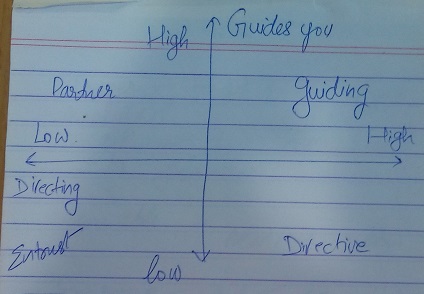
Classification of manager is done based on two vectors:
1. Guides you
2. Directs you

Based on these two, manager might behave in 4 different ways: 1. High guiding, high directing: Guide 2. Low guiding, high directing: Directive 3. Low guiding, low directing: Entrusting 4. High guiding, low directing: Partner Caveat: based on how well your manager understands you with time, her behavior might change in terms of her guiding and directing. Classification of worker is done based on following two vectors: 1. Skill 2. Will
Based on these two, worker might behave in 4 different ways: 1. High skill, high will: Performer 2. Low skill, high will: Learner 3. Low skill, low will: Underperformer 4. High skill, low will: Demotivated Three tips on managing up: 1. Bring solutions, not problems 2. Solve your boss's problems 3. One challenge rule # Handling angry client or boss is best done by asking clarifying questions. Ask for examples. # People don't leave jobs, they leave bad managers. # Circle of yelling (a concept showed in the TV show "How I met your mother"). Your boss yells at you so you go home and yell at your wife. Your wife is a teacher who yells at her student. That student is the child of your boss so because of being yelled at throws a temper tantrum at home which aggravates your boss who started the circle by yelling at you. It continues to repeat creating the circle.

Tuesday, March 17, 2020

Personality Categories (Social Behavior Types) based on Merrill-Reid Styles


Overview of Model 

The method used by most management training workshops and employers is the ever-popular Merrill-Reid method, which categorizes personality types into 4 as:
 Driver
 Expressive
 Amiable
 Analytical

These styles are defined by two behavioral variables or dimensions: assertiveness and responsiveness. Assertiveness = the degree to which a person's behaviors are seen by others as forceful or directive. Responsiveness = the degree to which a person's behaviors are seen by others as emotionally controlled. More responsive people react noticeably to their own emotions or to the emotions of others. Less responsive people are more guarded in their emotional expression. While no one style works better than any other, flexibility has been shown to distinguish the success manager of conflict from the unsuccessful. Flexibility = the ability to get along with people whose styles differ from one's own. Comparison with Other Methods: 2 of the 3 Jung Typologies are same with this method, Extroversion-Introversion (E-I) and Thinking-Feeling (T-F) vectors. Jung Typology Tests differ in one vector (Sensing-Intuition, S-N) and Myers Briggs differs with another vector Judging-Perceiving (J-P). Studies from Jung Typologies: Extroversion-Introversion (E-I) Extroversion-Introversion (E-I) is the most important scale. The developers of Jung personality test have calculated that about one third of the population is extroverted. You may be extrovert when you concentrate on people and the environment around you. However, you are considered introvert when you focus on your thoughts and ideas. Sensing-Intuiting (S-N) Sensing – Intuiting (S-N) is the next scale denoted. In it about 75 % of the population belongs to sensing. Thinking-Feeling (T-F) Thinking - Feeling is the third scale represented by (T-F). These are dispersed evenly through the population, as two-thirds of men are thinkers, while two-thirds of women are feelers. --- --- --- --- DISC test uses the same vectors and is very close to this approach. It only differs by creating a sub-category. The 4 personality types approach creates a foundation for further self analysis and provides the basic framework for understanding one’s self. Characteristics of 4 Personality Categories  Driver: o Objective-focused o Know what they want and how to get there! o Communicates quickly, gets to the point o Sometimes tactless and brusque o Can be an "ends justify the means" type of person o Hardworking, high energy? Does not shy away from conflict  Expressive: o Natural salesmen or story-tellers o Warm and enthusiastic o Good motivators, communicators o Can be competitive o Can tend to exaggerate, leave out facts and details o Sometimes would rather talk about things than do them!  Amiable: o Kind-hearted people who avoid conflict o Can blend into any situation well o Can appear wishy-washy Has difficulty with firm decisions o Often loves art, music and poetry Highly sensitive o Can be quiet and soft-spoken  Analytical: o Highly detail oriented people o Can have a difficult time making decisions without ALL the facts o Make great accounts and engineers o Tend to be highly critical people o Can tend to be pessimistic in nature o Very perceptive
Table of Equivalents for the 4 Types in Various Personality Tests
APPLICATIONS Step 1: Self-Evaluation - With a 15 minute survey (15 questions) we can map the selfperception of a person and categorize primary strengths and weaknesses. Step 2: Cross Check Self Evaluation - With additional cross-checking test (word selections) we can test the self perception and reliability of the self-evaluation. Step 3: 360 Tests for Comparisons - With 360 tests we can test self-awareness (are you aware how others perceive you?) and determine your gaps between self-perception and actual behaviors. Step 4: One-on-one coaching sessions – Personal Strategic Planning. Indentifying personal mission statement, vision, goals, values, strengths, talents, passions, role models through oneon-one discussions. More details on 4 types
The Analytical The Analytical is polite but reserved, logical, fact- and task-oriented. This person’s focus is on precision and perfection. Other strengths include persistence, diligence, caution, and a systematic approach. Weaknesses involve being withdrawn, boring, quiet, reclusive, and even sullen at times. If he or she seems indecisive, it’s because of a need to assess all the data. Perfectionism can be a fault if the Analytical pushes it too far. This person is definitely not a risk-taker. The Analytical needs to be right, and won’t openly discuss ideas until confident in a decision. His or her pleasure is accuracy. Pain is to be wrong and criticized. When communicating with an Analytical:  Be systematic, thorough, deliberate, and precise  Focus on the task  Be prepared to answer many “how” questions  Provide analysis and facts  Don’t get too personal  Recognize and acknowledge the need to be accurate and logical  Don’t rush unnecessarily  Expect to repeat yourself  Allow time for evaluation  Use lots of evidence  Compliment the precision and accuracy of the completed work. Portrait of an Analytical’s office The first thing you notice will probably be the glasses. The Analytical will have worn out his or her eyes from constantly reading everything. On the wall you may see a framed degree, but the chief decoration will be charts, figures, and graphs of every kind. The analytical is not very friendly, will often greet you skeptically, and doesn’t want to share much – especially anything personal. There will be no flowers or plant; for the Analytical, they belong in greenhouses. On the desk will be only business-related information, and that will be carefully arranged. It’s not a power office, but it definitely will be functional. As for color, black and white will do nicely. Symbol: Owl. The Amiable Devoted, consistent, dependable, and loyal, the Amiable is a hard worker and will persevere long after others have given up. He or she is a team player, cooperative and easy to get along with, trustful, sensitive and a good listener. Working in groups with cooperative individuals, the Amiable tries to avoid confrontation. He or she enjoys company, performs best in a stable environment, and often has a stabilizing effect on others. Weaknesses include indecision and an inability to take risks. Amiables are often too focused on others, conforming, quiet, and passive. They often won’t speak up for themselves, are too compliant and nice, and often painstakingly slow to make decisions. The Amiable’s pleasure is stability and cooperation. His or her pain is change and chaos. When communication with an Amiable:  Be relaxed and agreeable  Maintain the status quo  Be logical and systematic  Create a plan with written guidelines  Be prepared to answer “why” questions  Be predictable  Agree clearly and often  Use the word “we”  Don’t push  Don’t rush  Compliment him or her as a team player  Be a good listener Portrait of an Amiable’s office The first thing you will notice will be pictures of loved ones on the desk: husband, wife, family, favorite pets. They’ll be in a candid style, and the Amiable loves to talk about them. On the walls will be colorful photos of landscapes, waterfalls, birds, and sunsets. You’ll find flowers or plants that are growing well and office colors that are harmonious and restful. The person will almost certainly be dressed in colors that match. Furniture will be fashionable, but not overwhelming. Files are present, but usually kept out of the way. If you’re a little late, the Amiable won’t mind. If you have the Amiable in your company, he or she will stay with you. The Amiable likes company, newsletters, picnics, gatherings, and retirement parties. Symbol: Dove. The Driver The Driver is a high achiever – a mover and shaker who is definitely not averse to risk. The individual is extroverted, strong-willed, direct, practical, organized, forceful, and decisive. Look for someone who tells it the way it is and is very persuasive. Watch out or you’ll be worn down and bowled over. A driver is task- rather than relationship-oriented and wants immediate results. This individual is not concerned with how something is done, but what is being done, and what results can be expected. “What” is his or her battle cry. “What’s going on? What’s being done about it? What you should do is ...!” The Driver can be stubborn, domineering, impatient, insensitive, and shorttempered, with little time for formalities or niceties. He or she can also be demanding, opinionated, controlling, and uncompromising – or even overbearing, cold, and harsh. The Driver’s pleasure is power, control, and respect. His or her pain is loss of respect, lack of results, and the feeling that he or she is being taken advantage of. When communicating with a Driver  Focus on the task  Talk about expected results  Be businesslike and factual  Provide concise, precise, and organized information  Discuss and answer “what” questions  Argue facts, not feelings  Don’t waste time  Don’t argue details  Provide options. Portrait of a Driver’s office Of course, it must be the corner office with two windows, but the Driver never looks at the view. Pictures on the wall are of battlefields, maps, and boats. The Driver is a multi-tasked person and can sign letters, hold interviews, and talk on the phone simultaneously. Office furniture contributes to the impression of power and control, and is the most expensive and incredible available. The office may also contain flowers and plants, even exotic ones like orchids (carefully chose to contribute to the impression of power), but the Driver never looks after them. There’s an assistant to do that. On the desk are often family portraits, but never candid shots. They are formal portraits showing everyone in his or her proper role, frozen forever as the Driver sees them. The office will probably be decorated by an interior designer to create the feeling of power, and the colors of the office will be strong power colors. Curt and tough, straight to business. That’s the Driver at work in his or her den. Don’t waste time. Get straight to the point! Symbol: Eagle. The Expressive The Expressive, a verbally adept personality, is engaging, accommodating, supportive of others, persuasive, socially adept, and relationship- rather than task-oriented. He or she loves to be one of the gang, and is always ready for something new and exciting, especially if the gang is ready to participate. Additional strengths include enthusiasm, diplomatic skills, and the ability to inspire others. Weaknesses involve impatience, a tendency to generalize, verbal assaults, and sometimes irrational behavior. The Expressive can also be egotistical, manipulative, undisciplined, reactive, unorganized, and abrasive. The Expressive readily exchanges information and life experiences. His or her main need is to be appreciated and accepted. The Expressive’s pleasure is recognition and approval. His or her pain is isolation and lack of attention. When communicating with an Expressive:  Focus on developing a relationship  Try to show how your ideas will improve his or her image  Be enthusiastic, open, and responsive  Relate to the need to share information, stories, and experience  Be forthcoming and willing to talk  Ask and answer “who” questions  Remember to be warm and approachable at all times  Work to minimize his or her direct involvement with details or personal conflicts. Portrait of an Expressive’s office In short, it’s a mess. The Expressive loves favorite sayings and has them plastered on the wall or sitting on the desk. Files are never in a filing cabinet. Rather, they’re piled all over the office in stacks. But don’t be misled. The Expressive knows exactly where everything is and can find virtually anything by its location. Office colors will probably be loud and lively. If there are flowers or plants, they’re likely dead – either talked to death or lacking water. The Expressive’s greatest reward is personal acknowledgment from others, and examples of this will be displayed. The Expressive is an excitable dreamer, with lots of ideas and projects, but without the time to follow. Ref: www.timurtiryaki.com